Many registrars don't need convincing that microcredentials matter. They see the demand from learners, the interest from employers, and the growing pressure to offer shorter, more focused credentials alongside traditional degrees. Credential Engine's 2025 report counted 1.85 million unique credentials in the U.S. from more than 134,000 providers, and that number is only growing. The real challenge is getting micro credentials onto official academic records when the governance structures that control those records weren't designed for them.
How the transcript became what it is
Academic transcripts started as internal guidance tools, helping students and advisors track progress through the curriculum. Over time, they became something very different: the authoritative external record that employers, licensing boards, and other institutions rely on to verify what a person studied. As the diploma became more ceremonial and the transcript took on the burden of verifying actual learning and course-taking behavior, faculty governance bodies, accrediting agencies, and organizations like AACRAO all played a role in shaping what belonged on the official record. At most institutions, nothing goes on an official academic record without passing through curriculum committees first.
Faculty governance protects the rigor and institutional authority behind every credential. Early transcripts at some institutions actually included written faculty assessments of student achievement. Those richer records were largely abandoned after World War II, when the influx of GI Bill students made that level of detail logistically impossible. When mainframe computing arrived, expensive storage forced records even leaner. Faculty reinforced that boundary. Extracurricular learning, professional development, co-curricular achievements: none of it belonged on the official record.
The digital badge era and the governance gap
In 2011, Mozilla created the Open Badges project with funding from the MacArthur Foundation, establishing an open standard for digital badges. The ecosystem grew fast. By 2025, the 1EdTech Badge Count reported more than 320 million badges issued worldwide. Platforms like Credly and Badgr (now Parchment Digital Badges) became the primary infrastructure for issuing digital credentials, though the landscape continues to shift: the emergence of digital wallets, like WGU's Achievement Wallet and ASU's Pocket through the Trusted Learner Network, suggests credentials may not live on a single platform for much longer.
But at most traditional higher education institutions, the badges ended up on these external platforms, not on official records. It's not just continuing education divisions either. Departments, schools, and colleges have all launched micro credential programs while operating separately from the registrar's office and its governance structures, depending on the institution. The result is a parallel credentialing track: learners earn credentials that demonstrate specific skills, but those credentials live in completely different systems than their official academic record. Their learning journey is split across platforms, and some of the institution's most innovative programs carry no official academic weight.
Why governance matters more than you might expect
Registrars understand why faculty governance exists and why it's worth preserving. Consider the scale of credential fraud. Diploma mills represent a $2 billion industry in the U.S. alone, and researchers estimate the global academic fraud ecosystem at over $21 billion. During "Operation Nightingale," the DOJ found that more than 7,600 fraudulent nursing diplomas had been sold through three Florida nursing schools, with some individuals entering the workforce caring for patients.
When an institution puts a credential on an official record, it's making a promise about rigor and legitimacy. Without governance, the authority behind that promise becomes questionable. That doesn't necessarily mean the credential lacks integrity, but it does mean its standing can be challenged. This is the registrar's core concern: they want any credential bearing the institution's name to have real academic authority behind it. And not all micro credentials are equal. Some involve rigorous competency-based assessment. Others amount to showing up and paying. The variety is what makes governance so critical.
Institutions navigating this well
The institutions making real progress on microcredentials are building governance models that can accommodate new credential types while maintaining academic standards.
The University of Montana's Griz Career Skills program developed through Experiential Learning and Career Services, offers students a year-long career readiness program with five badged modules covering communication, critical thinking, teamwork, workplace excellence, and career development. The program is part of Montana's broader validated credentials initiative, which adopted NACE career readiness competencies as learning outcome standards, attaching new metadata to courses that makes records more explicit about what a learner actually achieved.
The University of Georgia launched its Comprehensive Learner Record in Fall 2025, rolling it out to all 36,000 undergraduate and graduate students. UGA's CLR captures learning both inside and outside the classroom: faculty and staff map courses and activities to institutional competencies so that completed experiences automatically populate each student's record. The Registrar's office led the initiative in partnership with academic affairs, making UGA one of the first institutions to implement this kind of system at scale.
Georgia Tech's curriculum governance structure shows what formal governance looks like at a research university. Their AMCM Subcommittee, established in Fall 2023 as a joint body of the undergraduate and graduate curriculum committees, specifically handles microcredentials, badges, and certificates. The Registrar serves as Secretary. Every proposal passes through this subcommittee before reaching the Academic Faculty Senate.
The University of Colorado Boulder deserves particular recognition. CU Boulder's registrar's office runs a microcredentials program directly, and the university has hosted the Badge Summit for over a decade, now in its eleventh year. It's become one of the field's leading gatherings for practitioners working through governance and implementation challenges.
AACRAO's Alternative Credentials Work Group has published guidance on approval protocols, learning outcome alignment, and record integration. Their Project Infuse initiative, launched in July 2025, is building public infrastructure to help institutions convert PDF transcripts into open, interoperable digital records.
Building a governance model at your institution
These institutions all took different paths, but common patterns emerge from their approaches and from AACRAO's best practices report. Microcredentials cross too many boundaries for any single office to own. The institutions doing this well have brought registrars, faculty governance representatives, continuing education leadership, and academic affairs to the same table. Montana went further by including employers in the design process, which gave their credentials labor market credibility from the start.
The governance body needs to answer several foundational questions: What types of micro credentials will the institution offer (for-credit, not-for-credit, stackable, standalone)? What assessment standards determine "completion"? Can credentials stack toward certificates or degrees? Where does each credential live: on the official transcript, a supplemental record, or an external platform? And who can propose a credential in the first place? Establishing clear answers to these questions early prevents the kind of ad hoc credentialing that weakens institutional trust.
AACRAO's report emphasizes aligning credentials with recognized competency frameworks, which is what Montana did with NACE standards and what UGA did by mapping activities to institutional competencies. The practical test for any governance body is: can we articulate what a learner who earns this credential knows and can do? If the answer is vague, the credential probably isn't ready for the official record.
Many institutions already have micro credentials on external platforms issued outside curriculum committees. Some of these programs are well-designed with real rigor behind them, even if they didn't go through formal governance. Institutions like CU Boulder and UGA show that there are ways to bring these credentials into the fold by establishing governance pathways that existing programs can be evaluated against over time.
Technology and the continuing education bridge
The organizational separation between continuing education and the registrar's office is one of the structural challenges underlying all of this. CE divisions operate autonomously with their own systems, their own faculty arrangements, and minimal coordination with academic affairs. That works for non-credit professional development. It breaks down when a working professional earns a micro credential through a CE division and later enrolls as a degree-seeking student asking: does this count? Can it go on my transcript?
AACRAO's Convergence initiative has been bringing registrars and CE professionals together to bridge this gap. On the technology side, 1EdTech manages the Comprehensive Learner Record (CLR) standard, which provides a data framework for documenting learning beyond traditional transcripts. AACRAO promotes it, and PESC offers a complementary approach through its JSON-LD Transcript standard. But standards alone don't solve the operational problem. Registrar offices need platforms that connect requirements data, student progress tracking, and academic planning into a coherent system.
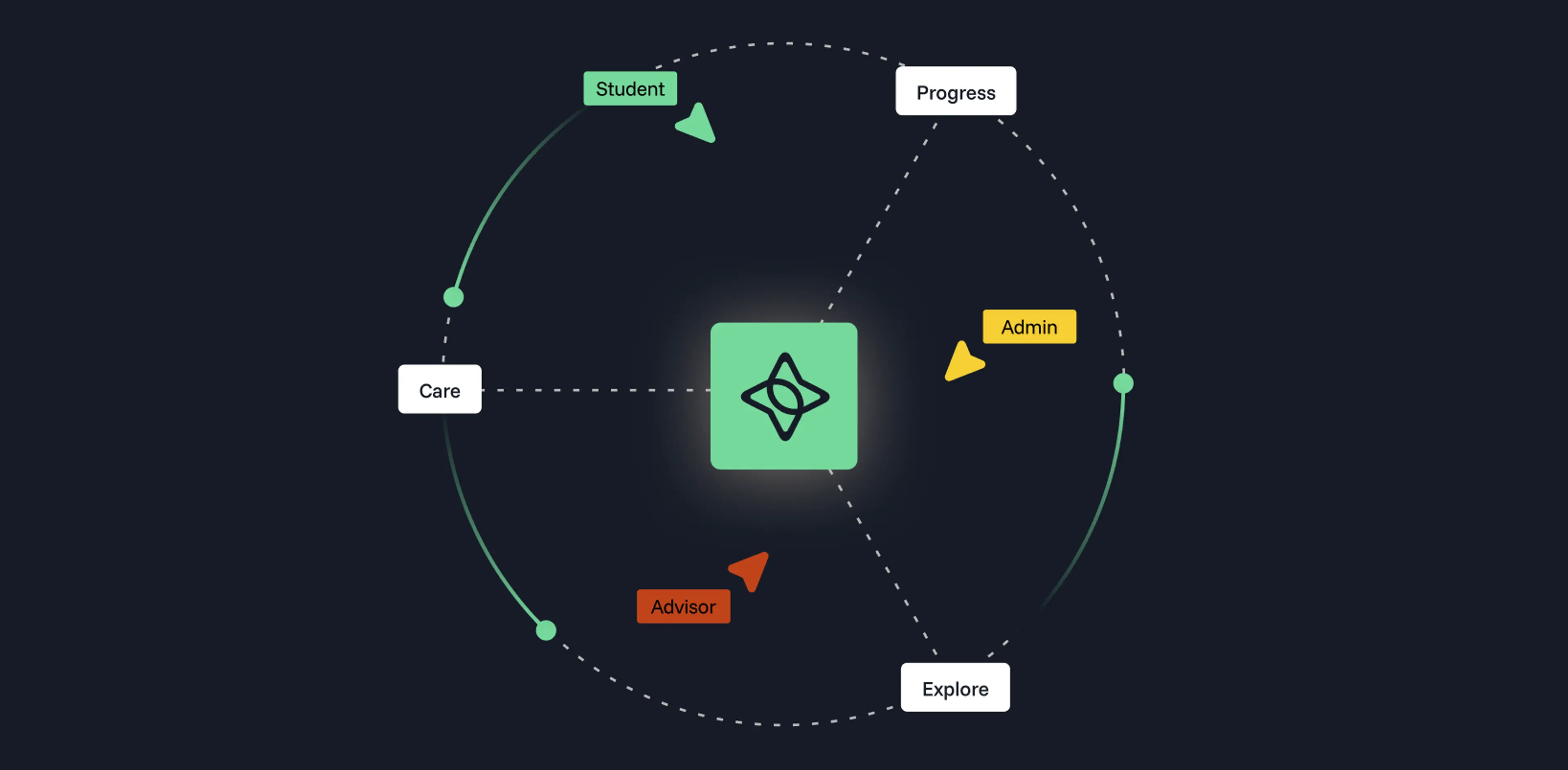
Platforms like Stellic are already rich with requirements data and function as record builders, helping registrar teams manage complex degree requirements and track student progress across non-linear pathways. When you consider that a minor is essentially a micro credential (a focused set of courses leading to a designation on the record), the technology for managing these credentials is closer than many people realize.
The registrar's strategic moment
The 2026 UPCEA report found that microcredential adoption has flattened at around 53% of institutions, nearly identical to 2021. Registrars are uniquely positioned to break that stall. They understand governance, they own the official record, and they see how credentials flow through an institution from curriculum approval to transcript issuance to employer verification. The registrars leading on this are building governance models, advocating for the right technology, and positioning their offices as strategic partners in institutional innovation.
As microcredentials increasingly earn a place on official academic records, the registrars who shape how that happens will define the next chapter of credentialing at their institutions.
If you're thinking about how to prepare, we'd welcome the conversation. Stellic works with registrar teams at community colleges and research universities, and we're always interested in hearing what's happening on your campus.