Choosing a degree planning or student success platform is one of the more consequential technology decisions a campus can make. The stakes are real: students who lack clarity on their path to graduation are more likely to stop out, advisors stretched across large caseloads cannot give every student the attention they need, and institutions without reliable data on academic progress are left making important decisions without the full picture.
The technology matters, but success depends far more on how the decision is made than which product is ultimately selected. Schools that treat this as a discrete software purchase often find themselves with a tool that never fully lands. Schools that treat it as a student success strategy and build their internal process accordingly tend to get far more out of it.
This guide reflects what we have seen work across the schools that have gone through this evaluation: the questions that surfaced the right information, the steps that built durable internal consensus, and the moments where process made the difference.
First: Know What You're Choosing Between
The market for this category of software breaks into four distinct types, and they are not interchangeable.
ERP-native audit modules are the degree audit tools built into your SIS, whether that is Banner, Workday, or PeopleSoft. They handle the records side of audit well, but they were designed for administrative use. Updating program requirements often requires IT involvement, and the student experience tends to be an afterthought.
Advising platforms handle appointment scheduling, notes, caseload management, and early alerts well. Their degree tracking and planning functionality is usually thin or bolted on from an acquisition, which means planning gets treated as an add-on and often requires duplication of the program requirements which becomes a maintenance nightmare.
Integrated platforms bring audit, planning, advising, and transfer management into one shared, student-facing system. They are built on the premise that all of these functions need to talk to each other and designed for the student to use, not just the staff. As one partner institution put it, the goal is a campus where adding a platform actually reduces complexity rather than compounds it.
Most schools already have pieces of this puzzle. The question is whether they have the connective tissue. Three tools that do not share data, do not reflect real-time changes, and require a student to navigate three different interfaces are not a system. They are a patchwork, and the gaps between them are where students get lost.
Get the Right People in the Room
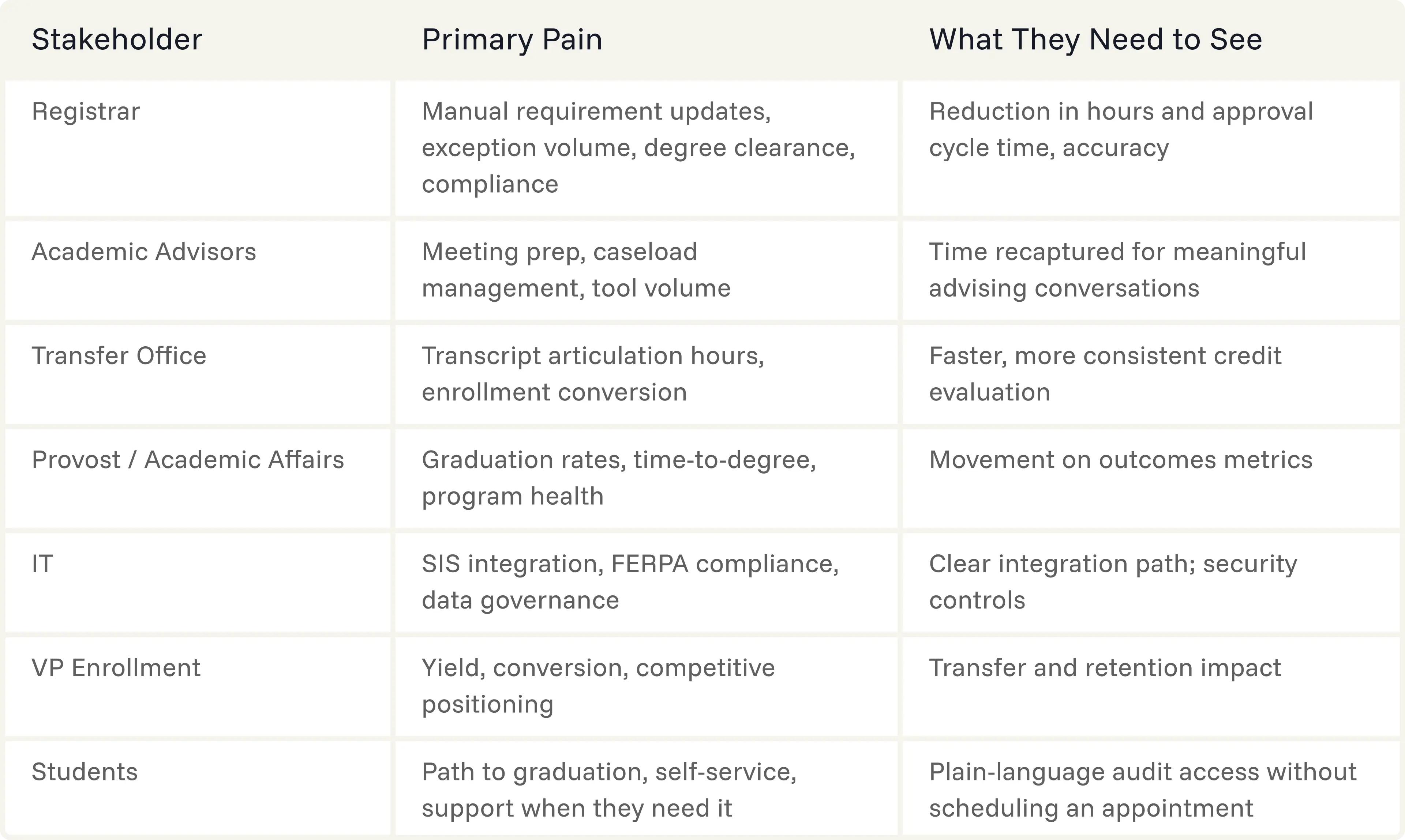
Schools that struggle after implementation usually had one office drive the purchase. The ones that succeed treat it as a cross-functional initiative from the start. The business case, the demo process, and the success criteria should reflect more than one perspective.
One team worth involving earlier than most schools do is IT. They are often brought in after a vendor is selected, when the integration questions are already overdue. IT will have questions about your SIS integration architecture, data governance, FERPA compliance, and long-term maintenance burden that will surface eventually. Better to surface them during the evaluation, when they can shape the decision.
At a mid-size Catholic research university, what began as a degree audit project became a catalyst for building shared understanding across offices. One leader reflected that the process humanized the Registrar's Office for advisors. That kind of alignment starts with getting the right people in the room early, before the vendor is selected and before the implementation plan is written.
Build Your Business Case Before You Build a Shortlist
This is the step most schools skip, and it is the one that determines whether a project builds consensus and excitement. The hard part is translating the need for change into a document leadership will act on. The questions below are designed to help you quantify the cost of your current state in terms that resonate in a budget conversation: hours, revenue at risk, and outcomes.
Staff Efficiency: Quantify the Hours
ROI formula: (Meetings/yr × avg duration × % transactional) × # of advisors = hours lost to work software can handle. Example: 300 meetings × 0.75 hrs × 50% × 10 advisors = 1,125 hrs/yr
Research consistently shows that 40-60% of advising time is transactional without student self-service tools. The same logic applies to your Registrar team: how many hours go to manual requirements updates, exception routing, and degree clearance each year? For your Transfer Office, how many hours does a single transcript articulation take?
At a mid-size polytechnic university, substitution approvals that previously took five minutes per request are now completed in seconds. That is not a marginal efficiency gain. It is a fundamental change in what the team's time is available for.
Registration Leakage: The Waitlist Problem
Revenue at Risk = (Desired Credits − Actual Credits) × Waitlisted Students × Tuition/Credit
If 500 students each lose one credit to waitlist issues at $400 per credit, that is $200,000 per semester sitting in a spreadsheet that no one is acting on. Better planning data, connected to course scheduling, can help prevent it.
Student Outcomes: Baseline vs. Goal State
Gather your current numbers and define a realistic goal state for each. The metrics that tend to matter most to leadership are FTIC retention (full-time and part-time), six-year graduation rate, transfer-out rate, and average credits achieved per semester. These become your post-implementation success criteria and the language your provost speaks.
Current System Costs: The Full Picture
Compare total cost of operation, not just license fees. What is your current system's annual recurring cost in years two and beyond? What does it cost to train new staff, in time as much as money? And what are the hidden costs: staff hours on workarounds, manual data re-entry, IT maintenance, and processes that exist only because the system cannot handle them automatically? The real cost of staying is almost always higher than it appears on the renewal invoice.
What Good Looks Like: Evaluating Vendors
Transfer & Pathway Management
Transfer credit articulation should be automated where possible and auditable where manual review is required. Prospective transfer students should be able to explore how their prior coursework applies to specific programs before they apply or deposit. Students on non-traditional paths should have a clear way forward, not a system designed exclusively for four-year linear progression.
Student-Facing Planning & Self-Service
Students should be able to see their degree progress in plain language, build and own a multi-semester plan alongside their advisor, explore pathways that fit their goals and timeline, and register for classes from the same connected experience. None of that should require switching between systems or waiting for an appointment and all of it should be accessible via phone.
Degree Audit & Requirements Management
A real-time, rules-based audit engine is the foundation everything else depends on. It should reflect changes immediately, not on a nightly schedule. Your registrar team should be able to update program requirements without filing an IT ticket, and exception workflows should be routed, tracked, and auditable with configurable approval paths. The system should handle dual degrees, double majors, minors, and certificates without special workarounds.
Advisor & Staff Tools
Advisors should enter every appointment with full context: a student's history, their plan, prior meeting notes, and risk indicators, without pulling information from three different systems. Petition workflows should live in the platform rather than in email threads, and reporting on advising activity should be available without a custom data request.
Integration, Security & Compliance
Your SIS integration should be certified and native rather than a custom-built connector that breaks when either system updates. The platform should be FERPA-compliant with role-based access controls and SOC 2 certified. Reporting and analytics should be configurable by your team, not dependent on vendor professional services for every new query.
How to Get the Most Out of a Demo
Come organized around initiatives, not features. Rather than asking whether a vendor has a what-if tool, try framing it this way: we are working to reduce the number of students who change majors in their junior year without a clear picture of what it means for their timeline. Show us how your platform supports that. That framing gets a more honest and useful answer.
Use the same scenarios across every vendor: walk through a real student audit, show a student exploring a major change from their own perspective, demonstrate a registrar updating a program requirements, and show an exception routed, approved, and reflected in the audit end-to-end. Consistency across vendors is what makes comparison meaningful.
Bring both a registrar and an advisor. They will notice completely different things, and both perspectives matter.
Questions Worth Asking Every Vendor
A few patterns are worth watching for before you wrap up an evaluation. If the degree audit and the advising platform are two separate products with separate logins, probe that. The same goes for a planner and audit that do not share the same data model. A platform built primarily for staff with a student-facing layer added later is another signal to dig into.
Bring these questions to every demo:
- Can you show us how similar the UI is between staff and student views?
- Who manages curriculum updates after go-live, your team or ours?
- What does your SIS integration look like: certified native, or custom-built?
- Can you walk us through how exceptions flow end-to-end?
- What is your average implementation timeline, and what typically drives variance?
- Who leads implementation: a dedicated team assigned to our school, or a shared services model?
- How do you help partners keep pace as the product evolves? What does ongoing enablement and support look like beyond the initial implementation?
- Can you connect us with a registrar and an advisor separately at a peer school?
- What do your partners wish they had known before going live?
If a vendor cannot answer these with specifics, that is as meaningful a signal as anything in their feature checklist. Independent validation matters too. G2 and Capterra carry verified peer reviews. Filter by institution type and size to find people in comparable situations, and your SIS user community is an underused resource for honest implementation perspectives.
Building Consensus Internally
Most projects that stall do not stall because the technology was wrong. They stall because the internal process was not built carefully or change management was not planned.
Start with the problem, not the product. Bring your quantified current-state data to leadership before you show anyone a demo. A VP who sees that advisor teams are spending 1,100 hours a year on transactional work, or that waitlist credit leakage represents $200,000 per semester in revenue at risk, is a different conversation partner than one who has simply been asked to approve a software purchase.
Include the skeptics early. The people who raise objections in procurement are usually the most vocal during implementation. Bringing them into the evaluation process converts potential blockers into co-owners. Give them a role: let the skeptical IT leader run the integration questions, let the resistant advisor lead the demo scenario for their use case.
Separate the audiences. The executive conversation is about outcomes: retention, graduation rates, revenue at risk. The operational conversation is about hours, workflows, and what changes on Monday morning. Conflating the two in the same meeting usually serves neither audience well.
Use peer evidence. A reference call from a registrar at a comparable school carries more weight in a cabinet meeting than anything a vendor will say about themselves. Arrange it before your recommendation meeting, and ask the reference to speak to both the process and the outcomes.
Define success before you sign. Agree on three to five measurable outcomes expected within twelve to eighteen months, build them into the contract where possible, and revisit them at your six-month check-in.
A Decision Worth Getting Right
Choosing this platform is not a procurement exercise. It is a commitment to how your institution supports students through one of the most consequential journeys of their lives. The schools that get the most out of it are the ones that went in with clarity about what they were solving for, built the right people into the process, and held themselves and their vendor accountable to real outcomes.
Before making that commitment, it’s worth thinking through the foundational questions around modernizing campus technology.
The technology will not do that work for you. But the right platform, chosen the right way, makes it possible.
Ready to take the next step? Request a demo.